Automotive
Exhaust Gaskets and Flanges: An Upgrade Towards Guaranteeing Optimal Exhaust Performance

Investing in new exhaust system flanges and gaskets may not be the most exciting upgrade an auto enthusiast can possibly make for their vehicle, but it’s undeniably one of the most important. And it doesn’t matter if the vehicle is still equipped with a factory fresh OE-spec exhaust system, or a low restriction aftermarket setup; exhaust flanges and gaskets are every engine’s vital keys to long term reliability.
Flanges and gaskets are essential for ensuring crucial pressure equalisation, and ultimately effective scavenging inside the exhaust system. Even on free-flowing, open collector competition engines, efficient scavenging is one of the most critical processes in the entire internal combustion cycle. That’s why owners who fully understand the role that flanges and gaskets play insist on using only the best.
Aftermarket Exhaust Flanges and Gaskets For Every Application
From their ability to reduce noise and engine compartment overheating, to their capacity to stabilise engine output and reduce fuel consumption, precision flange and exhaust gasket sets are among the best investments vehicle owners can make. These flexible space fillers are engineered to fill the gaps between exhaust system components, as well as between exhaust manifolds and engine heads.
It’s their excellent heat- and abrasion-resistant qualities, however, that makes them the first line of defence against uncontrolled exhaust gas movement, both inside and outside the exhaust system. While premium performance exhaust gaskets and flanges may not look the part of high-precision consumables, nothing could be further from the truth.
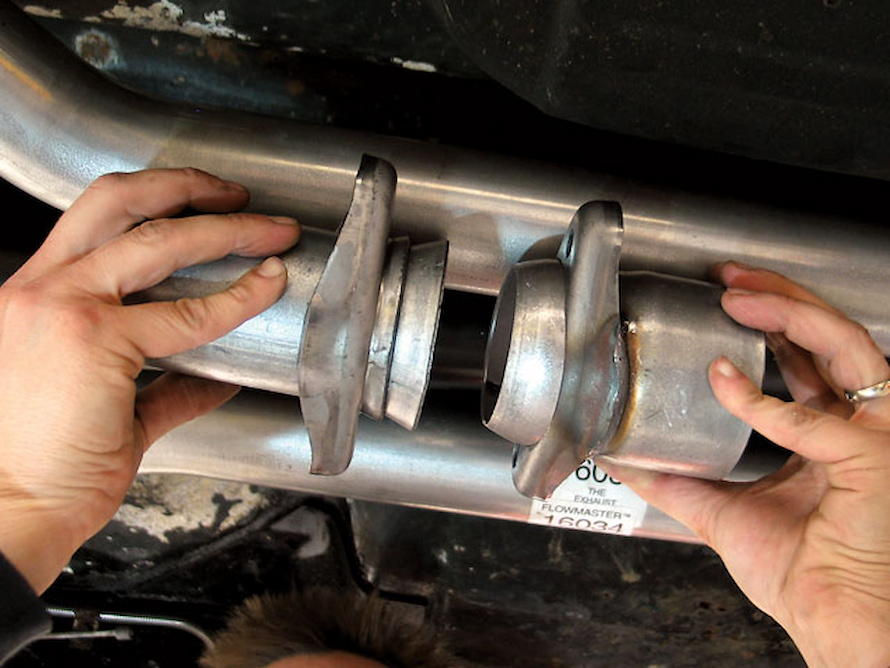
In spite of their seemingly rough fit, the engine-specific contours of gaskets, together with the unique diameters and thicknesses of flanges allows them to conform to their surrounding mating surfaces without deforming when compressed. That makes them perfect for:
- Improving engine performance. With their ability to form flexible, leak-proof seals between multiple exhaust system components, materials, and mating surfaces, gaskets and flanges are directly responsible for ensuring the smoothest possible gas flow and scavenging throughout the system.
- Reducing exhaust noise. By providing a leak-free, uninterrupted path directly to the resonator or muffler, gaskets and flanges play a significant role in reducing annoying exhaust frequencies and volume.
- Decreasing parts damages. As vibration can effectively cause loose, or poorly fitted exhaust tubes to either crack or fail completely, correctly sized and properly tightened gaskets and exhaust flanges can save drivers a host of costly, and potentially dangerous damages.
- Protecting the engine compartment. Even under normal operation, exhaust gas temperatures can regularly exceed 650°C. Exhaust gaskets and flanges prevent corrosive, super-heated gases from wreaking havoc with engine sensors, and other engine compartment electronics.
- Compliance with emissions standards. Australian Design Rules (ADRs) have strict guidelines for emission controls and release, and gaskets and flanges are an essential part of preventing the release of toxic carbon monoxide into the environment.
Regardless of engine size, compression ratio, or the type of fuel being burnt, it takes installing the right combination of exhaust gaskets and flanges to ensure that spent exhaust gases, heat-cycled tubes, and extreme vibration don’t become performance inhibitors. Their reliability depends heavily on the materials they’re constructed from, though. That’s why vehicle owners need to be sure that when they install aftermarket exhaust gasket and flanges, that they’re correctly matched for the engine, and the application they’re being used for.
Flange and Gasket Material Choices Made For Reliability
source: mjgasket.com
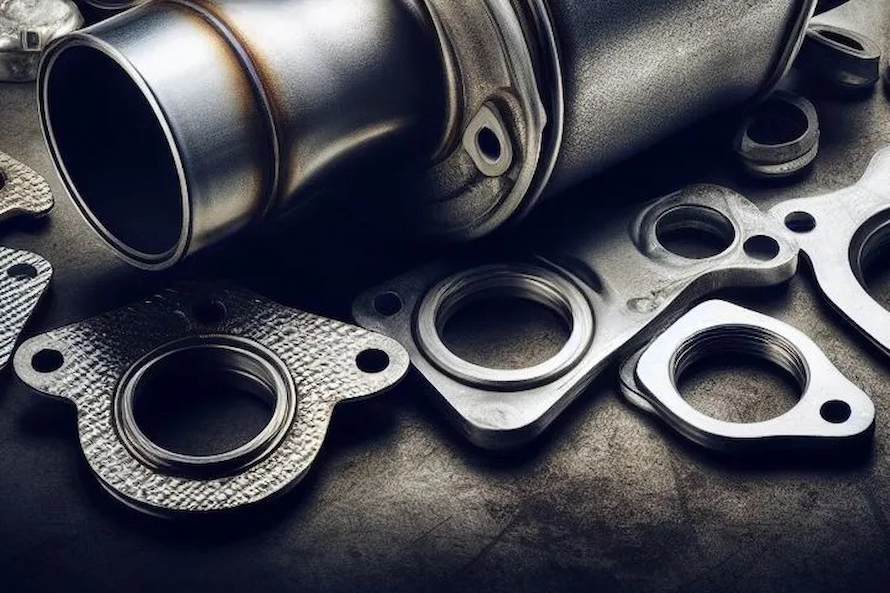
Not all exhaust gaskets, even ones that are labelled high performance, are constructed the same, or should be expected to perform the same. That’s because everything from the material the engine’s heads are constructed of to the type of driving being done will all have an impact on flange and gasket effectiveness, and ultimately, their reliability.
The complex catalytic converter and emission control components on a 1.2l Swift Hybrid requires a dramatically different exhaust flange and gasket combination than an ultra-high pressure 5.2l GTD Mustang with a supercharger. Fortunately, the aftermarket choices in material compositions are perfectly suited to reflect those differences.
- Compressed fibre, and graphite composite flanges and gaskets. Variable thickness composite flanges and gaskets are the most common gaskets used on the widest selection of exhaust systems, are frequently reinforced with wire mesh or metal laminate, and are noted for their superior seal retention up to 650°C.
- Multi-layer steel (MLS) gaskets. High pressure MLS gaskets are relied on especially for the even-sealing surfaces between engine heads and exhaust manifolds, and are constructed from multiple layers of steel that are sealed with high temperature outer layers of nitrile butadiene (NBR) or fluoroelastomer (FKM) rubber.
- MLS gaskets with a molybdenum disulphide (MoS2) coating. MLS gaskets coated with a dry MoS2 coating layer are notable for their reduced wear qualities, making them particularly suitable for high load applications where greater tensile strength is desired.
- Sandwich-type gaskets. Sandwich-type gaskets are typically used on high-temperature/high-pressure headed turbocharged and supercharged engines, and are constructed from thin layers of sandwiched metals such as steel, aluminium, or copper.
- Ceramic coated gaskets. With their ability to withstand operating temperatures to 1600°C, ceramic coated gaskets are best recognised for their durability, and superior heat and corrosion resistance, and are the optimum choice for competition and severe duty applications.
Material integrity is the cornerstone of exhaust flange and gasket reliability; and make no mistake, even modest decreases of time in a gasket’s ability to resist heat, its tensile strength, or ability to resist corrosion can be disastrous. That’s why it’s important to inspect exhaust systems regularly, and to be able to recognise when a flange or gasket needs to be replaced.
Signs and Symptoms For Replacing Flanges and Gaskets
Let’s be honest: while exhaust flanges and gaskets will, in most cases, last as long as a vehicle’s exhaust system, there are a variety of conditions where their reliability can be compromised. Pushing an engine or exhaust system to operate outside its designed temperature range, prolonged exposure to water or moisture, and even over-tightening during installation can all lead to premature exhaust flange and gasket failure, the clear symptoms of which are:
- Excessive engine/exhaust system noise. The first and most obvious indication of an exhaust flange or gasket failure is the sound of escaping exhaust gas, along with the unmistakable rattle of loose exhaust components.
- The pronounced smell of exhaust fumes. If an engine has undergone significant exhaust port work, is producing more power than delivered from the factory, and the gaskets don’t fit or aren’t rated for the increased output temperature, the smell of leaking exhaust and overheated material is going to be present.
- Severe fluctuations in engine speed. An unexplained rough idle, or surging and vibration under load are signs of an exhaust system that’s unsealed, and is suffering from reduced scavenging due to spent gases lingering in the tubes.
Recognising when exhaust system flange or gasket failure is eminent is the key to preventing complex and costly engine problems. The heat buildup, and extended stresses created by deformed or blown exhaust gaskets can damage catalytic converters and turbochargers, and even burn exhaust valves. In the same way that owners should always refrain from reusing worn or previously used flanges and gaskets, knowing when the ones installed on their vehicle are perilously in need of replacing is a part of that process.
The Final Word
At the end of the day, while there’s no question about why reliability is so important to a car or truck’s exhaust system, it’s important to remember that it’s not just about the tubes. The lightweight flanges and gaskets sealing them need to be just a durable as the tubes themselves, and owners need to be aware that when their gaskets fail, the rest of the system won’t be too far behind.
By choosing the correct precision flange and gasket sets for their application, owners can be confident that they’ve made the right step toward guaranteeing their exhaust’s performance, while also ensuring its reliability. It’s an investment that no owner will regret making.