Industry
Drill Press Guide: Different Types and Features Explained

When precision is something you want to nail on every project that requires making holes, drill presses are what you should consider. These motorised tools are made specifically for that, no matter if it’s wood, metal or plastic.
You can make holes in different diameters and you can also use the machine to counterbore or countersink said holes with ease and without the use of sanding tools. Similar to lathe machines, drilling machines use rotation as their core movement, but unlike lathes, drill mill machines are more versatile with their movement.
What Matters in a Drill Press
Swing
The distance between the column and the centre of the chuck times two is what’s known as swing size. It determines the thickness of the workpieces through which you can make holes. For instance, a modern and user-friendly drill press with a swing size of 20 cm means that you can make a hole in the centre of a 20 cm workpiece. If you’re going to be making holes more than 10 cm from the edge of your workpieces, then you need a press with a larger drill size.
Quill Stroke
Also known as spindle travel, it refers to the distance that both the drill bit can cover together when you turn the handle all the way down. You should look for a drill mill with a quill stroke no shorter than 10 cm. This is especially useful if you plan on making deep mortises.
Table Tilt
The table is where the workpiece sits and if it doesn’t tilt, it’s really not as useful to you since it just ends up being a fixed surface. A drill mill that allows you to tilt the table at least 45° on either side can help you implement more complex drilling techniques more easily, such as boring angled mortises, when you plan to make Windsor chairs.
Chuck
Drill mill machines have the drill bit held in by the chuck, which is a metal component that keeps the bit secure when in use. The capacity of the chuck refers to its opening and the larger the opening, the larger the bits you can use, thus the larger the holes you can make. There are also two types of chucks, keyed and keyless. Keyed chucks require you to use a key to secure the bit in place, while keyless chucks don’t, making them a more convenient solution.
HP
The number of horsepower a drill mill can have usually doesn’t exceed more than one. Typically, there are 1/2 HP or 2/3 HP drill presses, which are adequate for general-purpose applications, but if you need heavy-duty drill mills, then ones with more than 1 HP are the way to go.
Depth Stop
This feature allows you to set the press at a certain depth at which the drill bit will go down into a workpiece. If you need to make multiple holes with the same depth without issue, having a depth stop is a must.
Accuracy
While not all drill mill machines have it, the ability to make micro-adjustments when it comes to the depth of the hole you’re making, as well as its diameter, is a major advantage. Keep in mind, though, that this also increases the cost of the drill mill for sale.
Capacity
It’s not just about the size of the holes but how frequently you make them and how the press is able to stand the abuse. Typically, larger drill presses are more capable in that regard, but they are also not as portable.
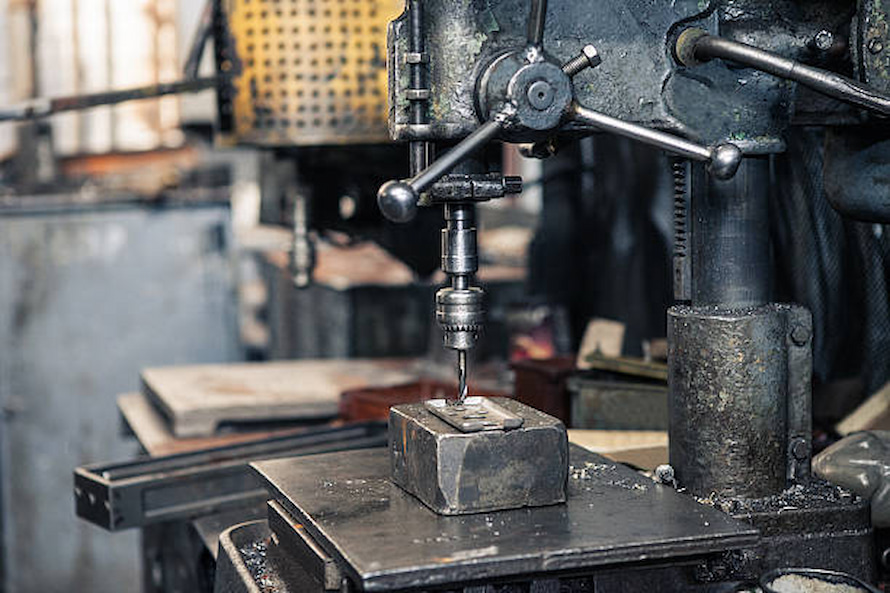
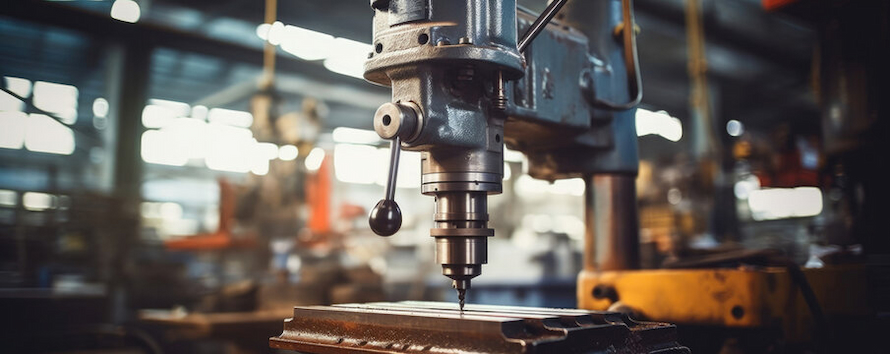
source: istockphoto.com
Types of Drill Presses
Benchtop
Probably the most popular type of drill press is a benchtop model, which is installed on your workbench. This is a compact unit that’s used for most light to medium-duty tasks. Their size makes benchtop drill presses usable in any workshop and you can easily relocate them when new equipment comes in.
Floor
With a freestanding drill mill machine, you get a more powerful and more versatile model when it comes to using larger workpieces. Although floor drill presses are more demanding in terms of power draw and running costs, they are far more capable, which makes them ideal for more demanding projects. Just keep in mind that they are more suitable as a permanent addition to your workshop.
Radial Arm
If you’re after more flexibility, then a radial arm model is what you should consider. That’s because you can adjust the arm of the machine horizontally, which allows you to place the bit over large workpieces.
Magnetic
A magnetic drill mill is even more versatile than a floor one as it can be mounted both horizontally, vertically and upside down on workpieces made of steel and iron. Typically used on jobsites, mag drills have a magnetic base that keeps them securely on the material.
Geared Head
Instead of belts, a geared-head drill mill for sale comes with gears that need to be replaced when due. This helps improve both torque and efficiency while making the machine more precise, especially when it comes to metalworking.