Industry
A Buyer’s Guide to Selecting the Right Stainless Steel Hinges

A long list of favourable properties, ranging from rust and heat resistance to exceptional strength and durability, makes stainless steel the go-to material in dozens of everyday and specialised commercial and industrial applications.
This includes building elements such as framework, cladding and facades in buildings and bridges. It’s also great for exhausts, body panels and engine components in cars and aeroplanes, operating tables and implants in medicine, and common household items such as cutlery, kitchen appliances and furniture.
The material is easy to machine and shape, is low-maintenance and has a sleek, modern appearance. Stainless steel is also the most widespread material used in the manufacture of hinges. These versatile yet often overlooked components provide easy opening and closing.
They also support heavy-duty industrial doors, and can be found with functional designs in kitchen cabinets, among a myriad of other uses. Let’s delve deeper into why durable stainless steel hinges are the preferred choice for the wide variety of doors, cabinets, enclosures and lids.
Stainless Steel Hinge Basics

source: intothewildvibes.wordpress.com
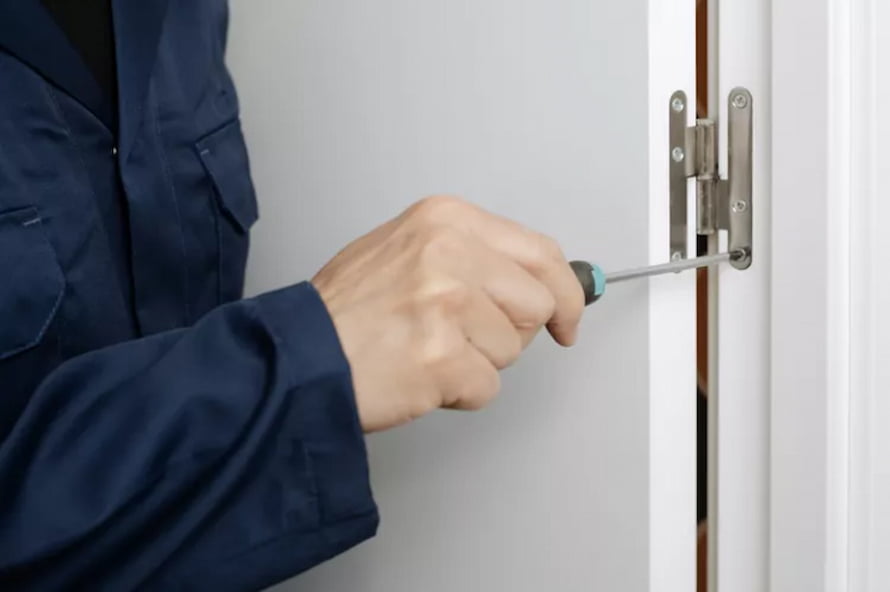
In their simplest form, hinges are mechanical bearings that connect two objects, such as doors and frames, allowing a limited angle of rotation. This provides the needed flexibility for effortless opening and closing. Hinges consist of several parts: the hinge leaf, knuckle (or barrel) and pin.
Leaves are the flat, rectangular parts attached to doors and frames on either side; knuckles are the hollow cylinders where the two leaves interlock, and pins slot inside the knuckle, connecting the leaves and providing a pivoting action. The parts can be optioned in different sizes and thicknesses to support objects of varying weights.
Where stainless steel types differ from regular (mild steel) hinges is the material composition. Based on iron and trace metals such as chromium, molybdenum and nickel, stainless steel hinges are stronger, more versatile and lasting solutions when connecting two pivoting objects. Specific materials can be chosen to meet design and operating needs, leading to different stainless steel grades.
More common are 304 stainless steel – an affordable option for everyday environments such as homes and offices, and 316 stainless steel for heavy-duty, outdoor use in areas exposed to corrosive substances, moisture and high temperatures. Moreover, the hinges can undergo several manufacturing processes to meet durability requirements.
This can also be used for higher production volumes without foregoing strength. This includes raw metal that is pressed or stamped in moulds in affordable, mass-produced parts, laser-cutting for precision and industrial applications. Lastly, there’s casting molten metal into pre-formed moulds for custom and heavy-duty variants in low production volumes.
Common Hinge Types Sourced in Stainless Steel
All common hinge designs can be optioned in stainless steel. This includes butt hinges in interior and exterior doors for high durability and corrosion resistance, sleek concealed hinges in high-end cabinetry and furniture, and continuous (piano) hinges running along the entire length of the door.
This is an ideal solution for supporting the weight of heavy doors in commercial and industrial applications (warehouses, factories, hotels, bank vaults, machine enclosures, hospitals etc). The latter are often paired with fire-rated and security systems to limit entry and exit.
Less widespread are flag hinges in decorative patterns for furniture pieces and Euro-style doors and windows, self-closing hinges with built-in springs in commercial spaces, and friction (torque) hinges, allowing connected objects to stay open at the desired angle.
Key Benefits
- Strength and durability: Choose heavy-duty stainless steel hinges for the exceptional weight loading, high strength and lasting functionality. These door components ensure effortless use without bending, warping or breaking, making them ideal for demanding applications.
- Corrosion resistance: Compared to mild steel and galvanised steel hinges, stainless steel types are resistant to rust and staining. This is important for outdoor gates, marine applications, and bathrooms, among other uses.
- Temperature resistance: Stainless steel performs equally well in a variety of temperature extremes, meaning hinges are regularly seen in fire doors, cold rooms, and production facilities with high heat.
- Low maintenance: The material is easy to clean and doesn’t require additional coatings. Periodic lubrication in hinges seen in high-traffic areas ensures smooth operation.
- Aesthetics: Sleek finishes and surface treatment (polishing and sandblasting) provide a modern and understated look for architectural doors, unique furniture pieces and industrial hardware such as tool cabinets and machine enclosures.
Main Buying Considerations
When buying hinges in stainless steel, consider the parts’ loading capacity, opening and closing angles and how the hinges are installed. Load capacities are dependent on design specifics such as leaf sizes and pin diameters, the hinge type, manufacturing process and steel grade.
Continuous hinges in higher tensile strength 316 steel in cast or laser cut designs generally have the highest weight loading. Decide how far doors and connected objects need to open, with 90 and 180-degree hinges being the more common types. Lastly, decide whether the hinges will be screwed to the supporting frames, welded or include quick-release mechanisms for quick removal or reattachment.